




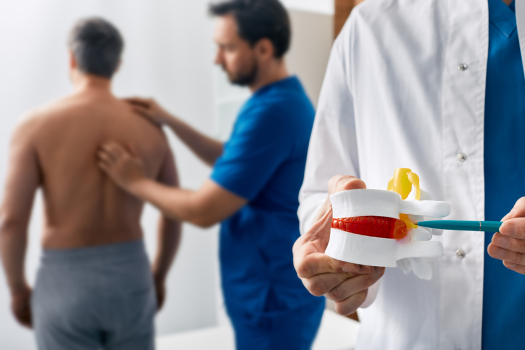
A reherniated disc can heal by itself, and most people recover without surgery. In many cases, the disc material responsible for the reherniation is gradually reabsorbed by the body. Recovery timelines vary, but conservative treatment resolves symptoms for the majority of patients within several months. In this article, we take a closer look at what drives that healing process, what slows it down, and when surgery becomes necessary.
What Exactly Happens When a Disc Reherniates?
A reherniation occurs when disc material pushes back out through a previously repaired or weakened annular wall, often at the same spinal level as the original injury. The inner nucleus pulposus leaks into the spinal canal, pressing on nearby nerve roots and triggering pain, numbness, or weakness. Reherniations are structurally similar to first-time herniations but tend to occur through tissue that is already compromised, making the surrounding annulus less stable and the recovery slightly more demanding.
The lumbar spine (particularly the L4-L5 and L5-S1 levels) accounts for the overwhelming majority of reherniations. Cervical reherniations are less common but follow the same biological principles.
How Does the Body Reabsorb a Reherniated Disc Naturally?
The body reabsorbs herniated disc material through a process called phagocytosis, in which immune cells recognize the extruded nucleus pulposus as foreign and systematically break it down. Larger, more extruded herniations (those that have migrated beyond the disc boundary) are reabsorbed most efficiently because they receive greater exposure to the vascular immune system. Contained herniations, which remain behind the posterior longitudinal ligament, reabsorb more slowly.
Research consistently shows the size of a herniation on imaging does not reliably predict the severity of a patient’s symptoms or their outcome. Many patients with large reherniations recover fully without intervention, while some with smaller ones require more aggressive care. This is why symptom management and functional progress are better indicators of healing than imaging findings alone.
What Are the Most Effective Conservative Treatments for Reherniation?
Physical therapy is the cornerstone of conservative reherniation treatment, with a structured program typically including core stabilization, nerve mobilization, and progressive loading to restore functional movement. Anti-inflammatory medications reduce nerve irritation during the acute phase, and epidural steroid injections provide targeted relief when pain is severe enough to interfere with rehabilitation. Activity modification (avoiding prolonged sitting, heavy lifting, and forward flexion during the early recovery period) protects the healing annulus from additional stress.
Most spine specialists recommend following a conservative treatment plan for several weeks before reconsidering surgical options, provided there is no neurological deterioration. The combination of pain control, guided movement, and patient education consistently produces strong outcomes and represents the standard of care for uncomplicated reherniations.
What Factors Determine Whether a Reherniation Heals Successfully?
Several factors determine the likelihood and speed of recovery from a reherniation. The size and location of the herniation matter: larger migrated herniations reabsorb more readily, while central herniations involving the spinal cord carry more serious implications. Patient age influences healing speed, as younger adults generally have a more robust inflammatory response that facilitates reabsorption. Smoking significantly impairs disc health by reducing blood flow to the surrounding tissue and limiting the oxygen supply that supports cellular repair.
Behavioral factors are equally important. Patients who adhere to a physical therapy program, maintain a healthy body weight, and avoid physically demanding activities during recovery consistently achieve better outcomes than those who discontinue treatment early. Psychosocial factors, including fear-avoidance beliefs and passive coping strategies, are also well-established predictors of delayed recovery and are addressed directly in modern rehabilitation programs.
When Does a Reherniating Disc Require Surgical Intervention?
Surgery becomes necessary when conservative treatment fails to produce meaningful improvement after a reasonable period of time or when neurological red flags are present. Cauda equina syndrome (a rare but serious emergency characterized by bowel or bladder dysfunction, saddle anesthesia, and progressive leg weakness) requires immediate surgical decompression and is not managed conservatively. Progressive motor weakness that worsens despite treatment is also a clear surgical indicator.
For patients without these red flags, microdiscectomy is the most common surgical approach for lumbar reherniations. It involves removing the extruded disc fragment through a minimally invasive incision, relieving pressure on the affected nerve root. Outcomes for microdiscectomy are generally favorable, though the risk of reherniation following repeat surgery is elevated compared to a first procedure, underscoring the importance of postoperative rehabilitation and long-term spinal hygiene.
How Long Does Recovery from a Reherniation Typically Take?
Most patients with reherniated discs experience meaningful symptom improvement within several weeks to a few months after beginning structured conservative treatment programs. Timelines vary among individual patients, but full recovery (defined as a return to all prior activities without pain or limitation) generally takes three to six months for mild to moderate cases. Severe reherniations with significant nerve compression or those requiring additional back surgery procedures may take six to twelve months or more for complete rehabilitation.
It is worth noting that imaging resolution often lags behind clinical recovery. A patient may feel fully functional weeks or months before their MRI shows complete reabsorption of the disc material. Relying solely on imaging findings without also considering functional milestones is a common source of needless anxiety and, in some cases, unnecessary intervention.
What Lifestyle Changes Can Prevent a Second Reherniation?
Core strengthening is the foundational long-term strategy for reducing the risk of future herniations. A stable, well-conditioned trunk reduces the mechanical load placed on lumbar discs during everyday activities. Low-impact aerobic exercise, such as walking, swimming, and cycling, maintains disc hydration and supports overall spinal health without generating the compressive and shear forces associated with high-risk activities.
Ergonomic awareness is equally important. Learning proper lifting mechanics, maintaining neutral spine posture during prolonged sitting, and managing body weight all reduce repetitive stress on the annulus fibrosus. Patients who complete formal spine rehabilitation and integrate these habits over the long term have significantly lower rates of recurrence than those who return immediately to prior activity patterns without modification.
Frequently Asked Questions
Is it common to reherniate the same disc twice?
Yes. Studies estimate reherniation rates following conservative treatment or microdiscectomy range from 5 to 15 percent, making it one of the more common complications of disc injury.
Can a reherniated disc heal without surgery?
Yes. The majority of reherniations resolve with conservative care, including physical therapy, anti-inflammatory treatment, and structured activity modification.
Does a reherniation always show up on an MRI?
Not always. Small reherniations are sometimes missed on imaging, and symptom severity does not consistently match what MRI findings suggest.
How do I know if my reherniation is healing?
Gradual reduction in leg pain, numbness, and weakness combined with improved tolerance for walking and daily activity are the most reliable indicators of nerve recovery and disc healing.
Is exercise safe while recovering from a reherniation?
Generally, yes. Low-impact movement is encouraged early in recovery. High-load activities, heavy lifting, and prolonged forward flexion should be avoided until cleared by a spine specialist or physical therapist.
Although discectomy surgery is generally a very successful procedure, a hole is left in the outer wall of the disc. Patients with a large hole in the outer ring of the disc are more than twice as likely to reherniate after surgery. A new treatment, Barricaid, which is a bone-anchored device proven to reduce the likelihood of a reherniation, was specifically designed to close the large hole often left in the spinal disc after microdiscectomy. In a large-scale study, 95 percent of Barricaid patients did not undergo a reoperation due to reherniation in the 2-year study timeframe. This treatment is done immediately following the discectomy—during the same operation—and does not require any additional incisions or time in the hospital.
If you have any questions about the Barricaid treatment or how to get access to Barricaid, ask your doctor or contact us today.
For full benefit/risk information, please visit: https://www.barricaid.com/instructions.
Comments